Courtly performance and the arranged face
Wolf HallCourtly performance and the arranged face describes how power in the novel is made visible, interpreted, and concealed through appearance. For Thomas Cromwell, the face is at once an instrument of political judgment and a mask required by advancement: he studies the expressions of others while learning to present an expression that will hold. The idea extends beyond courtly self-command to theatrical spectacle, public allegiance, and the private grief that performance cannot master.
Reading and arranging faces
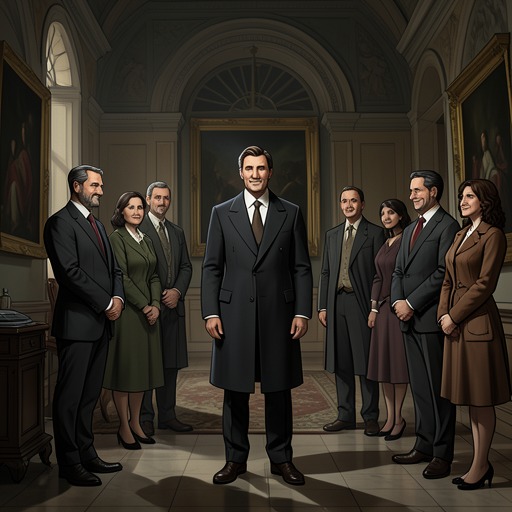
After Cromwell is sworn into the king’s council, he watches people closely for the instant when doubt, reservation, or rebellion registers before the face settles into the practiced smoothness of a courtier, facilitator, or yes-man. His attention is trained on the interval before the public expression is complete. Court politics depends not only on what people say but on the face they manage to show—and on the observer’s ability to notice what nearly escaped it.
The practice is reciprocal. Cromwell recalls Erasmus’s advice that a person should put on a mask before leaving home, and applies the lesson whenever he wakes in a castle, inn, or nobleman’s house. He has spent the early months of the year arranging his own face. Performance is not confined to a formal audience: it is a routine of movement through other people’s spaces, where one’s appearance must be prepared before one knows what the day will demand.
That discipline grows out of political uncertainty. When Rafe Sadler reports that the Duke of Norfolk suspects Cromwell knows where Wolsey’s supposed treasure lies and may ask him to serve him, Cromwell has to navigate a new patronage landscape without openly abandoning his former master. Rafe has secured Cromwell a seat for Taunton, but only with the king’s and Norfolk’s agreement; access to Parliament is itself shaped by the power of lords, bishops, and the king. Cromwell’s measured outward respect for Norfolk therefore accompanies continuing loyalty to Wolsey. His composed face belongs to a world in which allegiance, opportunity, and what can safely be said do not necessarily coincide.
Courtly display and private feeling
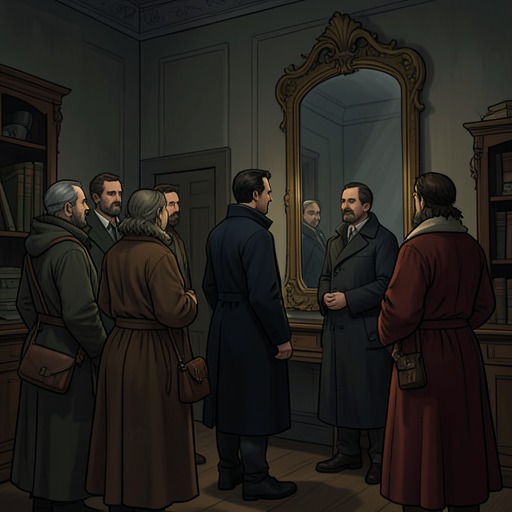
A later encounter with Johane makes the divided work of appearance more intimate. While discussing the king’s dispute with Katherine of Aragon and the riches of Cromwell’s household, she pauses before a mirror and deliberately changes her expression: she makes it lighter, more curious, and less personal. Cromwell notices the small adjustment. Her face, like his, is not simply a transparent record of feeling; it is something arranged for a particular encounter.
But his observation is interrupted by grief. He thinks of Liz Wykys, Johane’s sister and his dead wife, and recognizes that looking at another person cannot bring the dead back. The scene sets courtly attention against private loss: Cromwell can read a fractional change in Johane’s expression, yet his habitual looking has no power over what has already vanished. His wish to be good to her is expressed through an account of possessions and beauty, including his promise that she should have a fine mirror in which to see herself. The mirror becomes a gift, but also a contrast with his own unhealed memory.
The story he tells Johane about Florence sharpens that contrast. He describes people persuaded to burn their possessions, including their mirrors, until they can no longer see their own faces; then they return to houses emptied of beds, tables, stools, and food. For Cromwell, the mirrors are the worst loss because they prevent people from seeing how they differ from beasts. He hopes to be able to look himself in the face, and wants Johane to retain that possibility. The tale links material display to self-recognition: possessions may be destroyed, but the capacity to see oneself remains a more intimate measure of what has been lost.
Wolsey’s role after death
The court’s performance of Wolsey’s supposed damnation turns the dead cardinal into a spectacle. At Hampton Court, an interlude presents a vast scarlet figure dragged across the hall by actors disguised as devils. Norfolk laughs at the entertainment and proposes having it printed; Anne Boleyn applauds, while Henry sits beside her, at times laughing but appearing afraid. The scene makes political triumph into public entertainment, staging Wolsey as an object of ridicule before the court.
Cromwell sees the performance differently. He remembers that Wolsey died conscious and speaking of the king, rather than as the painless figure Cromwell had hoped he might have been. When the mock cardinal asks what wine the devil serves, Cromwell nearly laughs; the joke momentarily recalls Wolsey’s own voice. The scene’s apparent certainty—Wolsey condemned and the court free to mock him—cannot contain the living force of Cromwell’s memory.
Behind the screens, the theatrical illusion breaks into ordinary work. The actors remove their masks and struggle out of their costumes; George Boleyn, Henry Norris, Francis Weston, and William Brereton are disclosed as the men who played the devils. The figure of Wolsey is revealed as Sexton, the fool known as Master Patch. Cromwell watches as Patch sheds the padded scarlet costume, then speaks to him about the roles each man is paid to perform. The exchange makes the interlude’s artifice explicit: a fool can play a cardinal, and courtly entertainment can make a political enemy into a disposable part.
Patch’s jokes turn the performance back on Cromwell. He knows Cromwell’s low origins and challenges the authority behind the man’s present position; Cromwell answers that fools cannot speak without limit where his writ runs. Their encounter brings status and performance into direct contact. Patch can mock the authority he does not possess, while Cromwell’s answer asserts the power attached to his office. Neither role is secure: the fool can speak, but his survival depends on the indulgence of others; the official can command, but the mockery recalls the precariousness of his beginnings.
Performance, power, and what remains
In these episodes, arranged appearance is not merely deception. It is a method of reading unstable alliances, moving among patrons, and preserving a place in a court where a man may be judged before he has spoken. Cromwell’s skill lies in observing others as carefully as he manages himself. That skill has limits, however. It cannot restore Liz, silence Patch’s knowledge of his origins, or prevent the court from turning Wolsey’s death into a pageant.
The final image at Austin Friars gives the tension a material form. Cromwell looks at the cardinal’s arms, whose scarlet hat has recently been retouched, and orders that they be painted out. When asked what should replace them, he says to leave a blank. The request refuses the easy substitution of one emblem for another. Wolsey’s visible insignia can be removed, but the empty space registers the absence that spectacle and political succession cannot simply fill. The novel thus places the arranged face alongside the blank wall: one is a practiced surface for surviving power, the other an admission that some losses remain visible precisely because nothing can stand in for them.